
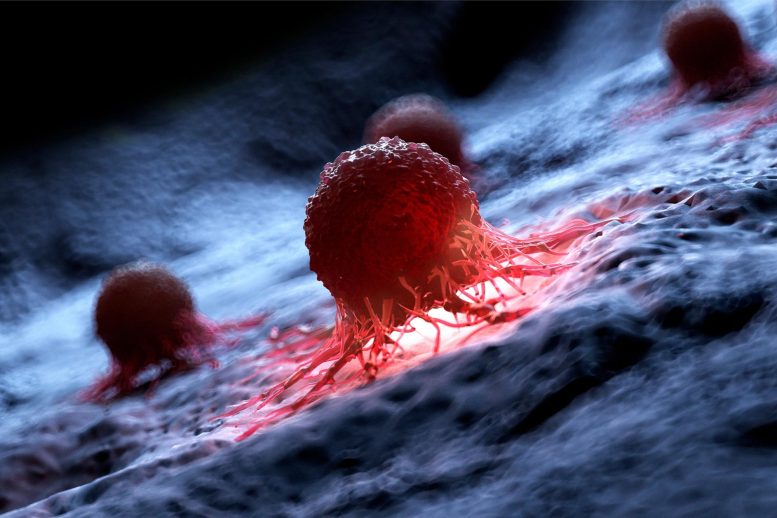
Nanoparticles With Antibody Fragments Cured Gastric Cancer in Mice
A multi-institutional team of researchers discovered that a new cancer therapeutic, which combines antibody fragments with molecularly engineered nanoparticles, permanently eliminated gastric cancer in treated mice.
The results of the “hit and run” drug delivery system was recently published in the journal Advanced Therapeutics and represents the conclusion of a collaboration spanning over five years between Cornell University, Memorial Sloan Kettering Cancer Center (MSKCC), and the biopharmaceutical company AstraZeneca.
“I’ve seen beautiful results before, but I’ve never seen something that eradicates a tumor like this,” said study co-lead author Dr. Michelle Bradbury, MSKCC director of intraoperative imaging and professor of radiology at Weill Cornell Medicine.
The other co-lead authors are Ulrich Wiesner, the Spencer T. Olin Professor in the Department of Materials Science and Engineering, at Cornell Engineering; and J. Anand Subramony, vice president of protein engineering research and development at AstraZeneca at the time of the study.
Targeted cancer treatments such as antibody and nanoparticle therapies have seen narrow clinical use because of each therapy’s limitations, but the new therapeutic – an evolution of what the researchers call Cornell prime dots, or C’ dots – combines the best attributes of both into an ultrasmall, powerfully effective system.
A ‘Hit and Run’ Therapeutic Mechanism
As they are silica nanoparticles just 6 nanometers in size, C’ dots are small enough to penetrate tumors and safely pass through organs once injected into the body. Wiesner first developed them more than 15 years ago and, in collaboration with Bradbury, published a 2018 study that found an antibody fragment-nanoparticle hybrid to be especially effective in finding tumors.
This collaborative work with AstraZeneca set off the search for a new, molecularly engineered therapeutic version of this immuno-conjugate.
AstraZeneca “site engineered” fragments of antibodies so they would effectively attach to the C’ dots and target HER2 proteins associated with gastric cancer. The team optimized fragment conjugation to the C’ dot surface, along with specialized inhibitor drugs developed by AstraZeneca. This enabled the nanoparticles to carry about five times more drugs than most antibodies.
The final product was a version of C’ dots, armed with cancer-targeting antibody fragments and a large drug payload, all packed into a sub-7-nanometer, drug-immune conjugate therapy – a first of its kind in that size class, according to the researchers.
“We describe the mode of action as ‘hit and run,’” Wiesner said, “because the C’ dots either target the tumor microenvironment and kill the tumor cells or get safely cleared out of the body via renal clearance as a result of their small size, thereby minimizing off-target accumulation and associated side effects and toxicity.”
Mice with gastric cancer received three doses of the therapeutic. Not only did the treatment eradicate the disease in every mouse, but there was no evidence of tumor recurrence after nearly 200 days.
“Usually you’d have to couple the treatment with other therapies to see those kind of long-term results,” Bradbury said. “It showed that the very detailed, careful work of this team – the years spent on the stoichiometry and the surface chemical developments – it paid off.”
Bradbury underscored the versatility of the C’ dots platform, and said she envisions it being used not as a replacement for antibody treatments, but as a complementary tool that can be adapted to different types of cancers and other specific needs of patients.
“C’ dots have become unusually efficacious and safe in treating cancer. They completely obliterated the tumor, even at the cellular level,” said Wiesner. “This is what we ultimately had hoped for and it further supports our earlier decision to bet on therapeutic C’ dot applications.”
Wiesner and Bradbury said the research behind the new C’ dot therapeutic will be continued by Elucida Oncology, a startup company they founded to help bring the technology to market. They said that while Elucida is not using antibody fragments in their current clinical trial of C’ dots, the work will help them build new conjugates that can potentially utilize such fragments in future trials.
Reference: “Engineered Ultrasmall Nanoparticle Drug-Immune Conjugates with “Hit and Run” Tumor Delivery to Eradicate Gastric Cancer” by Li Zhang, Virginia Aragon-Sanabria, Anusha Aditya, Marcello Marelli, Tianye Cao, Feng Chen, Barney Yoo, Kai Ma, Li Zhuang, Thais Cailleau, Luke Masterson, Melik Z. Turker, Rachel Lee, Gabriel DeLeon, Sebastien Monette, Raffaele Colombo, Ronald J. Christie, Pat Zanzonico, Ulrich Wiesner, J. Anand Subramony and Michelle S. Bradbury, 19 October 2022, Advanced Therapeutics.
DOI: 10.1002/adtp.202200209
Never miss a breakthrough: Join the SciTechDaily newsletter.
Follow us on Google and Google News.
1 Comment
Antibody treatments? Why is it I feel like this is not a treatment an average person could EVER afford…. Hope for the RICH springs eternal.